
Investing in Property to Fund Education – A Complete Guide to the Concept
The number of international students in Australia continues to climb, attracting more than 600,000 students each year from over 200 countries around the world.
Australia lies in the southern part of the globe, and in this nation of just 23 million people, the number of international students ranks third in the world, behind only the United Kingdom and the United States. Australia has abundant educational resources and a world-leading education system. With less than 0.5% of the world's population, it contributes 3% of the world's scientific research output.
Australia has more than 1,100 educational institutions offering over 22,000 courses. In the Universitas 2012 U21 Ranking of National Higher Education Systems, Australia ranked eighth, ahead of countries such as Japan, Germany and the Netherlands. At the same time, the Australian government has consistently worked to nurture outstanding talent, allocating 200 million dollars in education funding to reward young people who excel in various fields. This nation, renowned worldwide for its spirit of exploration and innovation, attracts learners from all over the world every year."
The Australian Department of Immigration has officially announced the Streamlined Student Visa Framework (SSVF), a student visa policy to be implemented from 1 July 2016. How does the new policy differ from the previous one:
Point One: Opening up study opportunities for younger students
From 1 July 2016, Australia is opening its study policy to Chinese primary school students. Students aged 6 and over can apply for an Australian student visa, and one parent can choose to accompany them. By living and residing in Australia, they may find opportunities to obtain Australian permanent residency.
Point Two: A unified visa category
Under the new visa arrangement, all international students will apply for a unified visa category, streamlined from the previous eight categories down to two visa types: the subclass 500 (Student visa) and the subclass 590 (Student Guardian visa). This means that from 1 July 2016, regardless of which type of course a student chooses to study, all international students will apply for the same student visa (subclass 500). Under the new visa policy, the complexity of the study application process will be greatly simplified, making it far more straightforward and user-friendly.
Point Three: Applications will be made online
Under the new policy, all international students will apply online, greatly enhancing the security and convenience of the visa application process.
Point Four: Both the applicant's chosen institution and the risk level of the applicant's country of origin affect the visa documentation requirements
Under the SSVF framework, the Australian government uses a combined assessment of the risk level of the applicant's country of origin and the risk level of the chosen institution to evaluate the applicant's risk rating and the corresponding documentation requirements.
According to a 2015 research report by the Australian Government Department of Education and Training, the number of overseas students granted Australian student visas in 2015 was 645,185, an increase of 9.8% compared with 2014. In 2016, the number of overseas students grew to over 700,000.
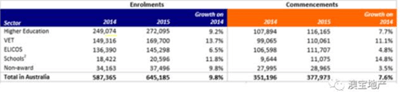
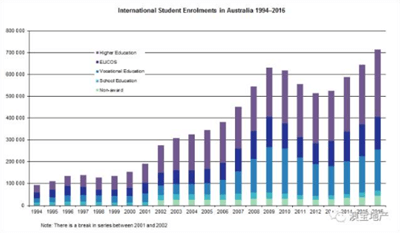
Across the Australian study market as a whole, students in higher education account for 42.2% of all overseas students in Australia. Within this vast cohort, Chinese students rank first, making up 35.7% of overseas students, with India in second place at 13%.
Because Australian property has strong potential for capital growth, once the annual property maintenance costs are deducted, the gains from capital growth can sometimes cover not only the tuition and living costs of studying in Australia but also generate a surplus. After graduation, whether you choose to sell the property outright or continue to rent it out, the profits generated could well allow you to achieve "zero-cost" study. Of course, not every Australian property can deliver such substantial returns—it is essential to choose projects with strong investment potential that are a focus of government planning. Aobo Realty offers a number of projects with excellent investment value; please feel free to enquire.
Stable rental returns
The Australian rental market is currently fairly stable, with low vacancy rates. Taking Brisbane as an example, the average vacancy rate sits between 2% and 3%, while the Gold Coast averages under 2%. Rental yields are also around 4.5%–7%. If you purchase a property while studying, you can choose to rent it out as a whole or share the rent to cover or reduce the interest on your home loan, achieving the goal of using rent to service the loan. The booming Australian study market, combined with the relaxation of immigration policy, underpins the stability of the Australian rental market. Not only can rent be used to service the loan, but it can also deliver considerable financial returns.
A source for your "first pot of gold"
Many overseas students face two choices as they approach graduation: one is to stay in Australia and find a stable job, and the other is to return home. If you choose to return home but would rather not job-hunt in the employment market, you can use the appreciation of your Australian property as your start-up capital, achieving your initial accumulation of wealth. Whether you choose to stay in Australia or return home to start a business, the profits that funding your studies through property brings will make you grateful for the decision you made.
Freehold property with no inheritance tax
Looking at the current trends in Australia's economic development, the investment concept of funding study through property can not only deliver a considerable income; based on property data over the past 50 years, Australian house prices have doubled every 7–10 years.

In 2015, the exchange rate also fell significantly and now sits at around 1:5. Compared with coming to Australia to study or invest in property a few years earlier, this has substantially reduced costs. So the current Australian market—whether in terms of exchange rate, capital growth or investment potential—represents a relatively good time to invest.