
The Key Differences Between Buying Property in Australia and China
Many Chinese buyers are currently very keen on investing in Australian property, so what are the differences between buying property in Australia and buying property in China?
1. Term of Ownership
Australia
The vast majority is freehold.
There is no inheritance tax, so property can be passed down through generations. Transferring ownership to immediate family members as an inheritance is exempt from stamp duty.
China
70 years, after which the ownership status is undecided and the land renewal fees are undetermined. A property tax may also be introduced.
2. Loan-to-Value RatioAustralia
Buyers with Australian residency can generally borrow up to 80% or even more.
Overseas buyers with an Australian work visa, Australian income and who meet the bank's various lending requirements can borrow up to 80%.
For overseas buyers with no local Australian income, Aobo Realty can assist you in borrowing up to 50%–70% of the property price.
China
Loan terms vary by region. Most cities have policy restrictions on loans for second homes, with fairly strict requirements and limited borrowing amounts.
3. When Repayments Begin
Australia
No loan repayments are required while the property is still under construction and before handover.
For off-the-plan property, you only need to pay a 10%–20% deposit upfront, and any interest earned on the deposit before settlement is also returned to the buyer at settlement. The buyer only begins repaying the loan after the property settles.
China
Bank loan repayments begin immediately after signing the contract.
4. Where the Deposit Goes
Australia
The deposit (10%–20%) is held in the developer's solicitor's trust account. The developer can only access this money once the property is built and passes government inspection.
This protects the consumer's interests and also holds the developer accountable for construction quality.
China
The deposit goes directly to the developer to build the property.
China has some of the highest deposits in the world, with the deposit for a first home being 20%–30% and for a second home 50%–70%, at an interest rate 1.1 times the benchmark rate. Deposit ratios vary by region.
5. Unfinished Developments
Australia
There is no risk of developers absconding with the funds.
Banks only approve a loan once the developer meets certain pre-sale targets. If these requirements are not met, the bank will not approve the loan, and the deposit and interest are returned to the client.
China
There is a risk of unfinished developments, because developers use buyers' deposits to build while selling.
If a developer cannot secure ongoing funding, the project may be left unfinished. With no oversight of the funds, buyers may suffer losses.
6. Vacancy Rate
Australia
Brisbane and the Gold Coast have an average vacancy rate of around 2.2%
and rents across Australia are stable.
China
In 2016, the overall vacancy rate in urban areas nationwide was around 22%, and in some cities the vacancy rate for real estate projects was as high as 40%. However, the vacancy rates in major cities such as Beijing, Shanghai and Guangzhou are relatively very low.
7. Refinancing
Australia
Taking out a second loan is very easy, and you can even refinance against the increase in your property's value to fund the deposit on a second home.
You can apply to refinance in this way every few years.
China
Applying for another loan after already having one is very difficult, and such a policy barely exists.
8. Rental Yield
Australia
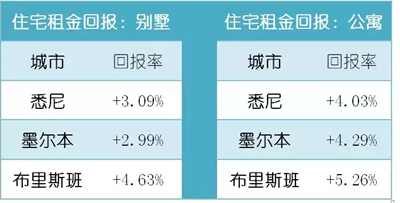
The return on a property investment is an important benchmark for judging whether a property is worth investing in.
China
Because property prices are so high while rents rise relatively slowly, the average investment return for ordinary residential property in the four first-tier cities of Beijing, Shanghai, Guangzhou and Shenzhen is currently below 2%.
9. Offset Account
Australia
A distinctive feature of Australia: you can set up an offset account alongside your loan, so the interest on your savings offsets your loan interest. The savings can also be withdrawn at any time for other purposes, though once withdrawn they no longer offset the loan.
China
Offset accounts do not exist.
10. Negative Gearing
Australia
With an investment property, rental income can offset the property's depreciation and other overall expenses, and where expenses exceed income, you can claim a tax deduction. However, this policy only applies to Australian tax residents.
China
No such policy exists.
11. Law & Solicitor Involvement
Australia
Australia's system is very rigorous, following the British tradition. Property sales use a third-party system handled by a real estate agent. Solicitors are involved throughout the transaction for both buyer and seller, protecting each party's interests, explaining the contract terms and putting the client's requests to the developer, at a cost of around A$1,500.
China
Transactions can be processed at a property exchange, and solicitor involvement is not mandatory.
The laws and regulations still need improvement.
12. Rental ManagementAustralia
Australian agents provide comprehensive services, and some even offer guaranteed rent to secure the buyer's rental income. Everything is handled within the framework of the law. Some agents offer additional services such as helping to apply for a bank loan or housing subsidy and obtaining a tax file number, saving buyers a great deal of time.
At the same time, Aobo Realty also recommends taking out landlord insurance, which covers both the property and the fixtures and fittings inside it, giving you complete peace of mind.
China
The management systems of domestic agents are improving. They are also shifting towards a one-stop service including advertising and finding tenants, gradually reducing situations where landlords and tenants have to handle matters themselves.
13. Capital Growth Potential
Australia
Australian property is market-driven, and policy has limited impact on property trends. Prices are mainly driven by population growth and a shortage of housing stock. Price growth is fairly stable, at 7%–10% per year, roughly doubling every 7–10 years. This is the behaviour of a mature market with relatively low risk. It is a steady market for medium- to long-term holding, and buyers with speculative intentions are not advised to choose the Australian market.
China
China's property prices once grew extremely fast — in the most extreme cases, prices in Shanghai could double in three months. In recent years, however, prices have been sluggish and heavily affected by policy.
14. Buyer Incentives
Australia
When Australian residents or PR holders buy their first home, the government may provide a subsidy based on the property price. In Queensland, for example, the government provides a First Home Owner Grant of A$15,000 for a new home, and some stamp duty may also be waived.
China
There are no incentives for first-home buyers, luxury homes are subject to double deed tax, and if a property is sold within two years, the full business tax is charged.
15. Freedom to Buy and Sell
Australia
Under private ownership, property can be bought and sold freely at any time, whether off-the-plan or completed.
China
The ownership transfer process is lengthy and subject to many restrictions.