Brisbane Set to Become Australia's Property Market Rising Star

The Australian property market has recently given many investors pause. This is understandable, because the Australian market is usually viewed only through the lens of Sydney and Melbourne, and over the past few months the figures from these two cities have looked somewhat gloomy.
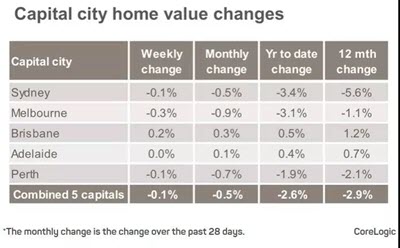
However, one city has bucked the trend and delivered an impressive performance. The latest Daily Home Value Index from CoreLogic, a well-known Australian property research firm, shows that Brisbane is the only capital city to have recorded price growth over the past week, month and even year (+1.2%), while Sydney and Melbourne fell 5.6% and 1.1% respectively, and the other five capital cities fell 2.9% on a combined average.
A number of property research firms, including CoreLogic, BIS Oxford Economics and NAB (one of the four major banks), have also published articles expressing an upbeat view on the Brisbane property market.
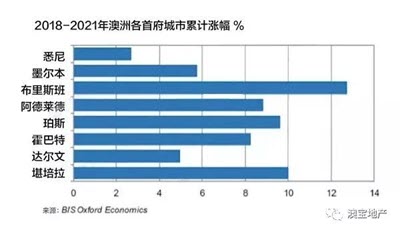
BIS estimates that Brisbane property prices will rise 2–3% per year in 2019–2020, and 5–6% per year in 2020–2021 — a period that also coincides with the completion of many of Brisbane's major infrastructure projects. Over the next three years, Brisbane will lead all capital cities in property price growth, with gains of up to 13%.
So let's take a look at why Brisbane will be Australia's best-performing property market in the years ahead:
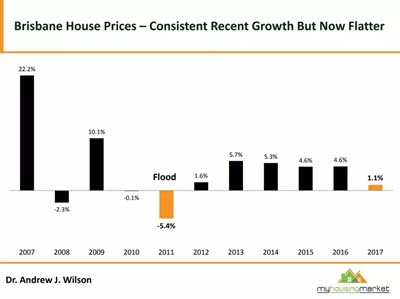
1. Brisbane is an undervalued city, currently sitting in a price lowHistorically, Brisbane recorded 22% price growth in 2007, when the price gap with Sydney was only 10%. Over the following 10 years, Brisbane's prices grew steadily and healthily at 4–5.7% per year. Although its price growth over the past decade has not been as rapid as Sydney's and Melbourne's, the market is healthier, with greater scope for the future and greater potential for growth. The table below sets out Brisbane's price growth from 2007 to 2017.
According to PRDnationwide's Affordable and Liveable Property Guide, Brisbane is Australia's most affordable and most liveable city. In Sydney, the house-price-to-annual-income ratio is 9.1, meaning a household would need to save 9.1 years of income without spending a cent to buy a home; in Melbourne, the ratio is 7.5. In Brisbane, it is only 5.9.
Likewise, in Sydney a household needs to put 48.4% of its annual income towards servicing a mortgage with an 80% loan-to-value ratio; in Melbourne it is 39.9%; while in Brisbane a household needs to devote only 31.7% of its annual income to mortgage repayments.
As a result, Brisbane has enormous scope for future price growth.
2. Queensland has overtaken Victoria as the state attracting the most interstate migrants
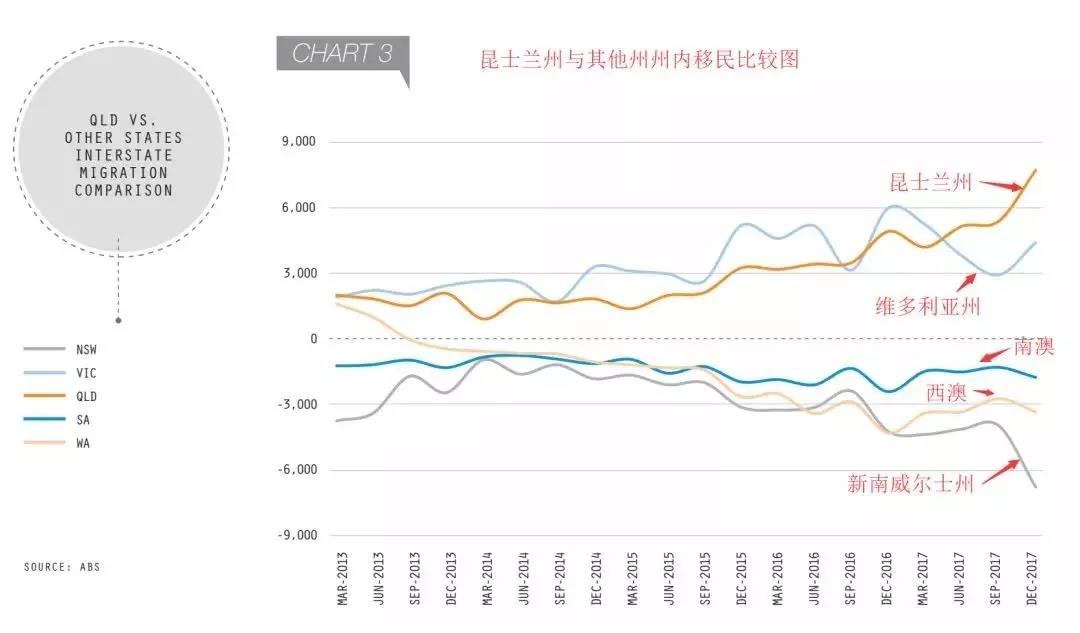
According to ABS data, in the fourth quarter of 2017 around 7,730 people moved to Queensland from other Australian cities, a large proportion of them from New South Wales. Ordinary residents are increasingly unable to afford Sydney's persistently high house prices, and once they find work in Queensland they move their families to a state with warmer, more pleasant weather and more affordable housing.
In 2017 alone, 22,500 people relocated to Queensland — the highest interstate migration growth in the past decade, surpassing Victoria. Let's look at the number of interstate migrants to Queensland from 2014 to 2017:
2014: 5,598 people; 2015: 8,236 people; 2016: 14,652 people. And last year, 2017: 22,500 people.
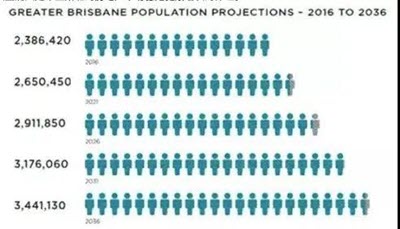
With interstate migration, overseas migration and natural births combined, Brisbane's population is growing at 50,000 people per year, and by 2036 it will reach 3.4 million.
3. Queensland's unprecedented infrastructure programme — the largest in Australia's history
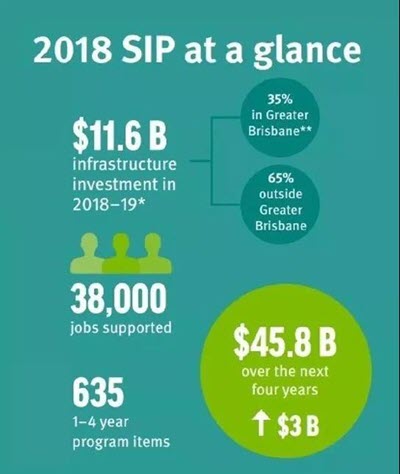
The Palaszczuk government's 2018 Queensland State Infrastructure Plan states that A$45.8 billion will be invested in infrastructure over the next four years, the largest infrastructure funding commitment since 2011. In 2018–2019 alone, A$11.6 billion will be invested in infrastructure, creating 38,000 jobs.
For Brisbane, major infrastructure projects include the A$4 billion Queen's Wharf Brisbane development, the A$5.4 billion Cross River Rail project, the A$2 billion Brisbane Live entertainment centre and the A$940 million Brisbane Metro. These projects will provide considerable employment both during construction and after completion.
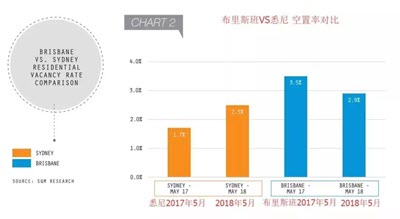
4. Brisbane's vacancy rate has fallen for the fifth consecutive yearThe vacancy rate is one of the best indicators for tracking supply and demand in the property market. SQM Research recently released the vacancy rate index for the major capital cities in May 2018: Brisbane's vacancy rate has continued to fall to 2.9%, down from 3.5% in the same period last year. Sydney's vacancy rate, by contrast, rose from 1.7% last year to 2.5% this year.
If this trend continues, it is quite possible that in the near future Sydney's vacancy rate will be higher than Brisbane's.