
Will Australia Raise Interest Rates in 2022? Will Rate Hikes Cause a Property Crash?
As is well known, central banks formulate macroeconomic policy by forecasting a country's future economic outlook, and adjusting the benchmark interest rate is one of their primary tools. The main factors they consider include future economic trends, the pace of income growth, and the inflation rate.
In November 2021, the Governor of the Reserve Bank stated that there was no intention to raise interest rates in order to curb rising house prices. In fact, whether to raise rates depends on whether the central bank believes the pace of economic recovery will effectively lift national incomes. If it will not, the central bank will not readily raise rates, as this would affect borrowers' ability to repay. Moreover, once the benchmark rate rises, it affects the repayment amounts on all variable loans, including commercial loans, reducing corporate profitability and further constraining wage growth.
But if rates really do rise, how would this affect the property market? Would it really cause a market crash, as some predict?
In reality, Australia's banking system is very conservative. When assessing loans, banks typically calculate the borrowing amount based on 70% or 80% of the applicant's income, and loans include a 2% buffer rate — that is, the borrower's repayment capacity is assessed on the current loan rate plus 2%. As a result, it is very unlikely that Australia would experience a situation like the 2008 US subprime crisis, where borrowers could not meet repayments and everyone rushed to sell off their properties.
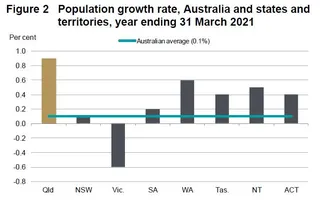
In addition, the continued growth in Australian house prices over recent years has been driven mainly by supply and demand: 1. Demand keeps growing. The chart below shows population growth by state over the past 12 months, with Queensland standing out as the strongest performer.
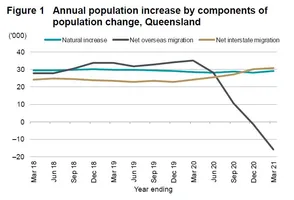
Aside from natural births, a major driver of Queensland's population growth is interstate migration, with large numbers of New South Wales and Victoria residents choosing to relocate to Queensland. This has fuelled rapid growth in demand for Queensland property. The table also shows that, due to the pandemic, overseas migration fell significantly over the past year. It is not hard to imagine that, once the pandemic eases, overseas migration figures will also turn positive, further intensifying Queensland's population growth.
2. The new-property market faces a shortage of land supply: land releases and approval times cannot keep up with demand. Meanwhile, listings in the established-property market continue to shrink. One important indicator is the ratio of the number of properties newly listed to the number sold over a given period. Over the past decade, this ratio has sat at around 0.9 — meaning that for every ten new listings in a given period, there were nine sales records. According to recent CoreLogic data, this ratio in Australia's state capitals now sits at a minimum of 1.2 and as high as 2.
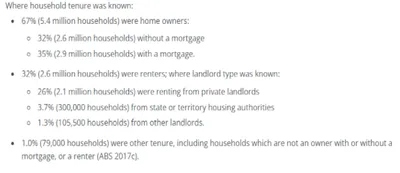
3. The Australian property market is predominantly owner-occupier-driven, and investors find it hard to sway house prices. In other words, property development and demand are largely underpinned by genuine, essential demand from within Australia. Australia conducts a national population and housing census every five years; the most recent was in 2016, as the 2021 census was not carried out due to COVID-19. According to the 2016 data, owner-occupiers accounted for nearly 70% of property transaction records that year.
4. With borders closed due to the pandemic, overseas investment has continued to decline. Even so, over these two years overseas investors still invested as much as A$6 billion in Australian residential property. Of this, 92% went into three states: New South Wales, Victoria and Queensland. Overseas investment accounts for only a small proportion of Australia's overall property sales — according to 2021 data from National Australia Bank, it made up around 2.2% of established properties and about 3.7% of new properties. Once the pandemic situation improves, overseas demand will also surge.
5. Investment returns: Take Brisbane as an example — vacancy rates are very low, at around 2%, and rental returns are high, with gross yields of at least 4%. Properties can essentially pay for themselves, offering a high level of investment security. Across Australia as a whole, compared with Sydney and Melbourne, Brisbane and the Gold Coast in Queensland — including some surrounding regional areas — have significant room for growth.