
Complete Guide to Stamp Duty in Australia
Australian property is favoured by high-net-worth individuals from around the world, thanks to its steady economic growth. Combined with relaxed rules governing foreign investment in the Australian property market, the outlook for steady medium-term capital growth in property prices is very bright.
In fact, compared with investing in other countries and regions, Australia is better suited to Chinese buyers in terms of both property prices and relevant policies.
Here, Aobo Realty would like to give everyone an overview of the three most popular cities for overseas buyers purchasing property in Australia: the three states in which Melbourne, Sydney and Brisbane are located - Victoria, New South Wales and Queensland — covering the home-buying policies for purchasers of different residency status, as well as the latest stamp duty rates and amounts.

Firstly, all overseas individuals may buy property within Australia. However, overseas individuals of different residency status are subject to different regulations when buying property in Australia.
1. Overseas individuals holding a temporary residence visa (meaning overseas individuals holding a visa valid for 12 months or more) may only purchase one established property. When submitting a FIRB application for an owner-occupied home, the applicant must be within Australia. Furthermore, the established property may only be used as the applicant's own residence and may not be rented out; it must be sold within three months of moving out.
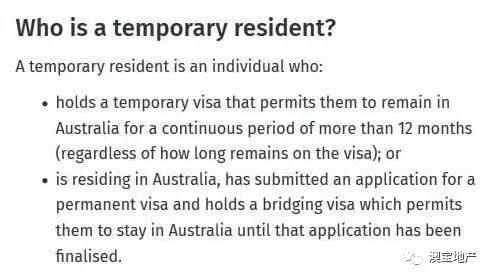
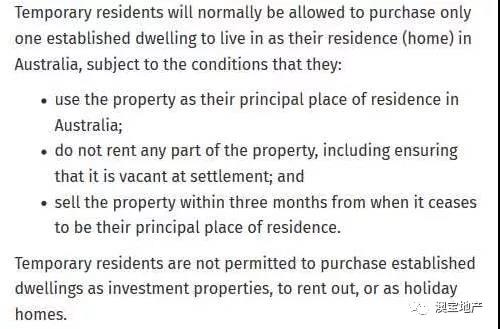
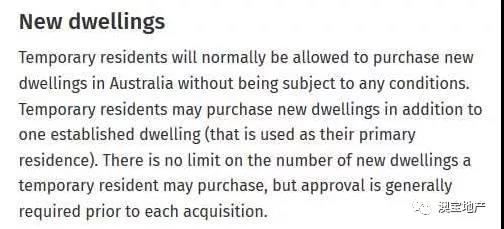
2. Overseas individuals holding a temporary residence visa are not subject to the above requirements when buying new property and may purchase any number of them.
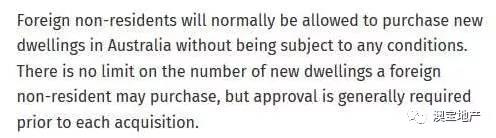
3. Overseas individuals without a visa, or whose visa is valid for less than 12 months, cannot buy established property; they may only buy new property or buy land to build on for investment purposes.

4. Overseas individuals holding a bridging visa cannot buy an established property on their own.
5. Overseas individuals holding a tourist visa cannot buy established property, even if the visa term exceeds 12 months.
With Australian property prices continuing to climb, the Australian government has repeatedly introduced overseas stamp duty to cool overseas investment enthusiasm, in order to encourage local residents to enter the property market.
In the 2016 financial year, the Victorian government introduced a stamp duty surcharge targeting "overseas buyers" purchasing residential property, making it the first state in Australia to implement overseas stamp duty. New South Wales and Queensland subsequently followed suit. Let's now look at the specific policies for the additional stamp duty and land tax in these three states. Below is a summary of the latest stamp duty policies in the three capital cities:
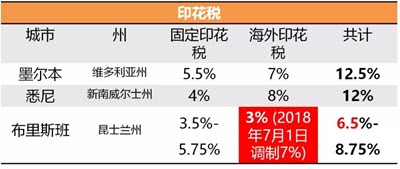
A friendly reminder: Friends interested in property in Queensland (Brisbane, Gold Coast), please be sure to sign your purchase contract before 1 July 2018 to avoid paying an extra 4% in overseas stamp duty. (For example, if you choose a property worth A$800,000, signing a contract after 1 July 2018 will require an additional A$32,000 in overseas stamp duty, equivalent to RMB 160,000.)
Melbourne – Victoria Overseas Stamp Duty Policy
Scope of application: foreigners or Australian temporary residents
Rate charged:
When overseas individuals buy off-the-plan property in Melbourne (Victoria), the stamp duty payable comprises two parts: a fixed 5.5% stamp duty + 7% overseas stamp duty (effective 1 July 2016), totalling 12.5%. See the diagram below for the detailed method of calculating stamp duty:
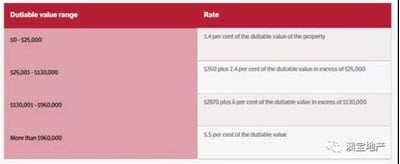
Such rapid policy changes have caused stamp duty to rise gradually year on year. Take an A$600,000 apartment as an example: from 1 July 2017, A$33,000 in overseas stamp duty is payable, for a total of A$75,000 in stamp duty.
For more information, please refer to the official website of the Victorian State Revenue Office: http://www.sro.vic.gov.au/node/1658
Sydney – New South Wales Overseas Stamp Duty Policy
Scope of application: foreigners or Australian temporary residents
In addition to the overseas stamp duty, an additional land tax also took effect on 1 January 2017. No surcharge is levied if you purchase commercial property such as a retail shopfront or office.
Rate charged:
From 1 July 2017, overseas individuals buying property in Sydney (New South Wales) must pay a 4% stamp duty + 8% overseas stamp duty, totalling 12%. There is also a 0.75% land tax surcharge, which will double to 2% after 2018. There is no stamp duty concession for buying off-the-plan property. See the diagram below for the detailed method of calculating stamp duty:
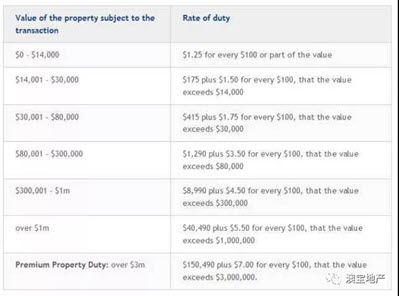
Before 1 July 2017, for a property worth A$800,000, both Australian citizens and temporary residents were charged A$31,490 in stamp duty. After that date, temporary residents must pay stamp duty of up to A$63,490 — an increase of A$32,000 in stamp duty alone.
For more information, please refer to the official website of the NSW State Revenue Office:
http://www.osr.nsw.gov.au/info/news/foreign-investor-surcharge
Brisbane – Queensland Overseas Stamp Duty Policy
Scope of application:
1. You are a foreigner or an Australian temporary resident.
2. A purchase contract signed before 1 July 2017.
Rate charged:
Depending on the individual property, a stamp duty of 3.5%–5.75% is charged, plus an additional 3% overseas stamp duty, totalling 6.5%–8.75%. See the diagram below for the detailed method of calculating stamp duty:
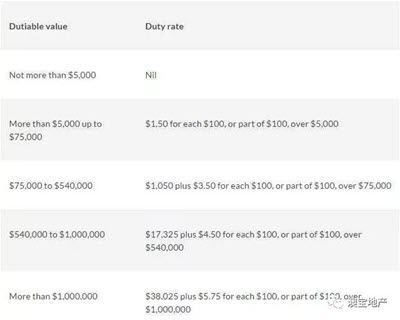
Case study: In Queensland, an asset worth A$800,000 attracts A$21,850 in stamp duty and A$24,000 in overseas stamp duty, for a total of A$45,850.
From 1 July 2018, the overseas stamp duty payable by overseas buyers purchasing property in Queensland will rise from 3% to 7%.
In other words, after 1 July, you will pay a total of A$77,840 in stamp duty.
For more information, please refer to the official website of the Queensland Treasury:
https://www.treasury.qld.gov.au/taxes-royalties-grants/index.php
From this analysis of the home-buying policies for overseas individuals across Australia's three largest capital cities, it is not hard to see that the direction of future overseas investment property policy will only tighten further. For overseas buyers, the message is to buy sooner rather than later — it will only become harder over time, and investment costs will only rise. Aobo reminds you once again: with only one month left until 1 July, are you ready to make your savings?